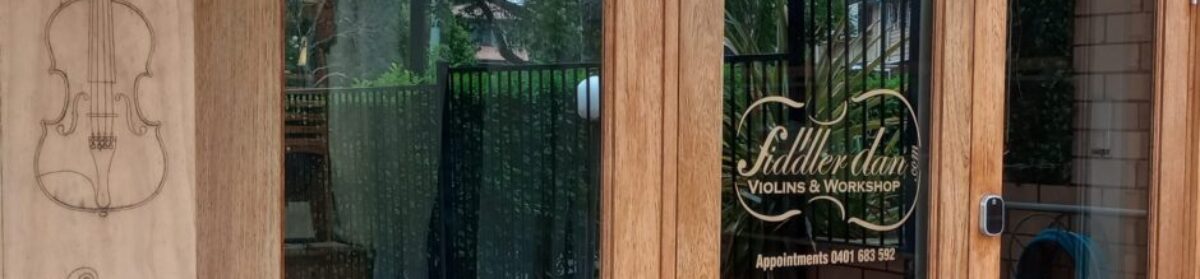

Stepping into the somewhat closed world of luthiery some years ago, I managed to find my way in under the watchful eye of violin maker David Brown—a long-time friend and resident maker at Montsalvat artist community in Victoria.
Further down the track, I had the opportunity to work alongside David Clark in Brisbane at Animato. A high-end cabinet maker in a previous life, he brings a wealth of knowledge about working with wood. There, I also experienced the production environment of a violin shop—repair work, workflow, and the rhythm of instruments coming across the bench—a valuable complement to traditional practice.
During this time, I also connected with others in the trade, sharing knowledge and learning from one another. Since then, I’ve been entrusted with instruments from across the community—keen amateurs, teachers, schools, and professional players alike. Somewhere in the midst of it all, a manner of expertise has begun to emerge from the sawdust.
At the same time, there’s the growing realisation that, as far as I’ve come, there is still much to learn—and ultimately, to translate into the pointy end of a chisel. I’m reminded of George Leonard’s writing in Mastery:
“Mastery is not about perfection. It’s about a process, a journey. The master is the one who stays on the path day after day, year after year.”
While I make no claims of mastery, I recognise the path—and take my small steps along it daily.
So, as I well and truly enter my journeyman phase of luthiery, the question becomes: where to next?

This is especially true in Australia, where expertise is lightly sprinkled across the country, not always easily accessible and often on the edge of retirement. One area of need that sits between my training in violin making and general repair work is restoration. Looking back at the clients I’ve had to turn away in previous years—many of whom still struggled to find someone to undertake the work in a timely manner—the gap became clear as a real need.
It’s here that I began to see where my own skills could grow to meet these unmet needs in the musical community. Developing restoration and varnishing skills in the authentic European traditions—particularly for older and higher-quality instruments—started to crystallise as the next step.
By a bit of serendipity, a friend and I were discussing the broader challenges facing the musical arts community, including the leap toward self-sustainability. I remembered that there were periodic fellowship opportunities supported by the Lord Mayor through a Creative Fellowship progrmme. I initially sought them it to pass on—but then came the lightbulb moment: why not have a go myself?
With the help of some generous supporters in the Queensland music community—people willing to articulate the need for these “old world” skills, and to vouch for my sincerity as an emerging luthier—the idea took shape.
So, thank you to long-time friend Timo Jarvela, string teacher and composer extraordinaire (with whom I once shared the front desk of a local orchestra many years ago), and to Warwick Adeney, long-time principal violinist of the Queensland Symphony Orchestra, for your letters of support.
Thanks also to the Early Music Society of Queensland—for whom I’ve worked on a number of repair/restoration projects (some waiting quite some time for the right hands)—and to National Music, a Brisbane-based music and string instrument distributor serving schools and local retailers, for backing the application and supporting my current work.
I submitted an application for a Lord Mayor’s Creative Fellowship late last year—and recently heard the good news I was awarded a creative fellowship to study “Italian varnishing and European Restoration Techniques”
Through this fellowship, I’ll be learning Italian varnishing techniques from Sofia Vettori, a third-generation Italian maker who violins are highly sought after and specialises in varnishing; together with violin restoration techniques from Iris Carr, an internationally respected restorer who trained at Charles Beare’s in London after graduating from the famed Newark School of Violin Making (which sadly recently closed its doors to full time study).

My first steps involve assembling pigments, resins, and materials from across Europe and Italy, alongside local art suppliers—and, inevitably, a few hippy shops for oils and gums. Diving into the course material and corresponding with the tutors, I find myself drawing again on my background in science. It feels a bit like being back in an undergraduate chemistry lab.
Once again, it’s that familiar intersection of science and music, striving to do my best and enjoying the learning journey.
Anyway—it’s back to the bench to grind some more pigments…
Putting it all together would not be possible with out the support and impetus of a creative arts fellowship from the Lord Mayor of Brisbane.
Other posts about my fellowship
- Violin Repair Books: Companions for the Journey
- A Journey into Violin Restoration with Iris
- Some violin varnishing projects
- A Journey Through Violin Varnish Recipes
- Italian Varnishing – A Journeyman’s Tale
- Journeyman on a Fellowship: Exploring European Techniques

The Lord Mayor’s Creative Fellowships are an initiative of Brisbane City Council